

Marine-grade concrete, fiber-reinforced composites (FRP), HDPE plastic systems, aluminum, and select fiber cement or properly treated wood are the strongest coastal exterior choices, in that order of long-term durability. Each one resists a specific threat that wears down ordinary building products near the water: salt intrusion, UV breakdown, or constant humidity. The right combination, backed by proper weather-resistive barriers and corrosion-resistant fasteners, is what separates a coastal home that ages gracefully from one that needs its siding replaced every decade.
TL;DR:
- Marine-grade concrete, fiber-reinforced composites, and HDPE plastics resist salt, UV, and humidity better than traditional materials, ensuring longer lifespan with less maintenance.
- Proper weather-resistive barriers and corrosion-resistant fasteners are crucial for preventing moisture intrusion and galvanic corrosion in coastal builds.
- Upfront costs for high-performance materials are higher but generally result in lower lifetime expenses due to minimal upkeep and durability.
- Material performance heavily depends on detailed connections, flashing, and fastener quality, not just on the material grade itself.
- Builders with expert coordination manage all aspects of material selection, installation, and permitting to maximize project durability and compliance in coastal environments.
Table of Contents
- What Makes a Material Right for Coastal Building?
- Which Protective Systems Keep These Materials Working?
- How Do You Prevent Fasteners From Corroding First?
- What Do These Materials Actually Cost Over Time?
- How Does NG Construction Apply These Materials in Real Projects?
- How Are Rising Sea Levels Changing Material Choices?
- What Building Codes Apply to Coastal Construction?
- What Coastal Homeowners Get Wrong About Material Choice
- Ready to Build With Materials That Actually Hold Up?
- Sources
- FAQ
What Makes a Material Right for Coastal Building?
Choosing coastal building materials comes down to three enemies working at once: salt, sun, and moisture. A material that handles Florida humidity poorly will fail even if it's rated for UV exposure, and a UV-resistant product that corrodes near salt spray is just as useless on a waterfront lot. The comparison below reflects how each material family holds up against all three stressors, not just one.
| Material | Best For | Salt/Corrosion Resistance | UV Resistance | Maintenance | Relative Cost | Typical Lifespan |
|---|---|---|---|---|---|---|
| Marine-grade concrete | Seawalls, piers, foundations | Excellent | Excellent | Low | $$$ | Long lifespan |
| Fiber-reinforced composites (FRP) | Docks, railings, cladding | Excellent | Excellent | Very low | $$$ | Extended durability |
| HDPE/modular plastic | Floating docks, fenders | Excellent | Good | Very low | $$ | Extended durability |
| Aluminum | Railings, frames, structural trim | Good (needs isolation from steel) | Excellent | Low | $$$ | Moderate lifespan |
| Fiber cement | Siding and trim | Good | Excellent | Moderate | $$ | Extended durability |
| Pressure-treated wood | Decking, boardwalks | Fair (needs upkeep) | Fair | High | $ | Shorter lifespan |
Marine-grade concrete earns its reputation in the splash and immersed zones, where ordinary concrete's reinforcing steel corrodes from chloride exposure. Research on concrete performance in marine environments shows that specially formulated mixes with reduced permeability resist chloride ingress far longer than standard mixes, which is why it remains the default choice for seawalls and pilings.
Fiber-reinforced composites have quietly taken over the dock and railing market. FRP systems resist corrosion, decay, and UV weathering better than vinyl or wood, and unlike wood, they don't spall or splinter after years of sun exposure.
HDPE and modular plastic systems dominate floating dock construction because they're chemically inert. Saltwater simply doesn't degrade them the way it degrades metal fasteners or untreated lumber, and the material is fully recyclable at the end of its service life, according to dock construction industry guidance.
Aluminum performs well for railings and structural trim, provided it's isolated from steel and other dissimilar metals. Left in direct contact with the wrong hardware, it corrodes fast. Isolated properly, it's one of the lighter, longer-lasting metal options for coastal exteriors.
Fiber cement siding gives coastal homeowners a wood-look exterior that won't rot, warp, or attract termites. It handles Southwest Florida humidity better than most siding materials short of full composite cladding.
Pressure-treated wood still has a place on coastal boardwalks and decks where homeowners want a natural look and accept the maintenance trade-off. It costs less upfront but demands sealing, staining, and inspection far more often than composites.
Which Protective Systems Keep These Materials Working?
The materials above only perform as promised when the systems behind them do their job. A weather-resistive barrier (WRB), a self-adhered underlayment, or a corrosion inhibitor is often what determines whether a wall assembly lasts 15 years or 40.
- Integrated WRB sheathing, such as ForceField, combines structural sheathing with a built-in drainage plane. Testing to ASTM standards shows ForceField achieving over 90% drainage efficiency behind rigid insulation and various claddings, which matters enormously in a climate where wind-driven rain finds every gap.
- Self-adhered roof underlayments, like VYCOR® ULTRA™, use a 100% butyl adhesive formulation rated for thermal stability up to 300°F, which makes them a strong fit under metal roofing in intense coastal heat.
- Mechanically fastened WRBs, such as WeatherSmart, balance water resistance with vapor permeability. The product is part of approved NFPA 285 assemblies behind fiber cement, brick, vinyl, and wood siding.
Statistic to remember: A drainage plane performing above 90% efficiency, the level ForceField demonstrates in testing, means far less trapped moisture behind your siding, which is often the real reason coastal walls rot from the inside out before anyone notices a problem on the surface.
Metal fasteners, flashing, and hardware need their own corrosion inhibitors or protective coatings, a detail covered next.
How Do You Prevent Fasteners From Corroding First?
Coastal builds rarely fail because the siding or decking gave out first. They fail because a cheap fastener corroded, let water in, and rotted the structure behind a material that was otherwise doing fine.
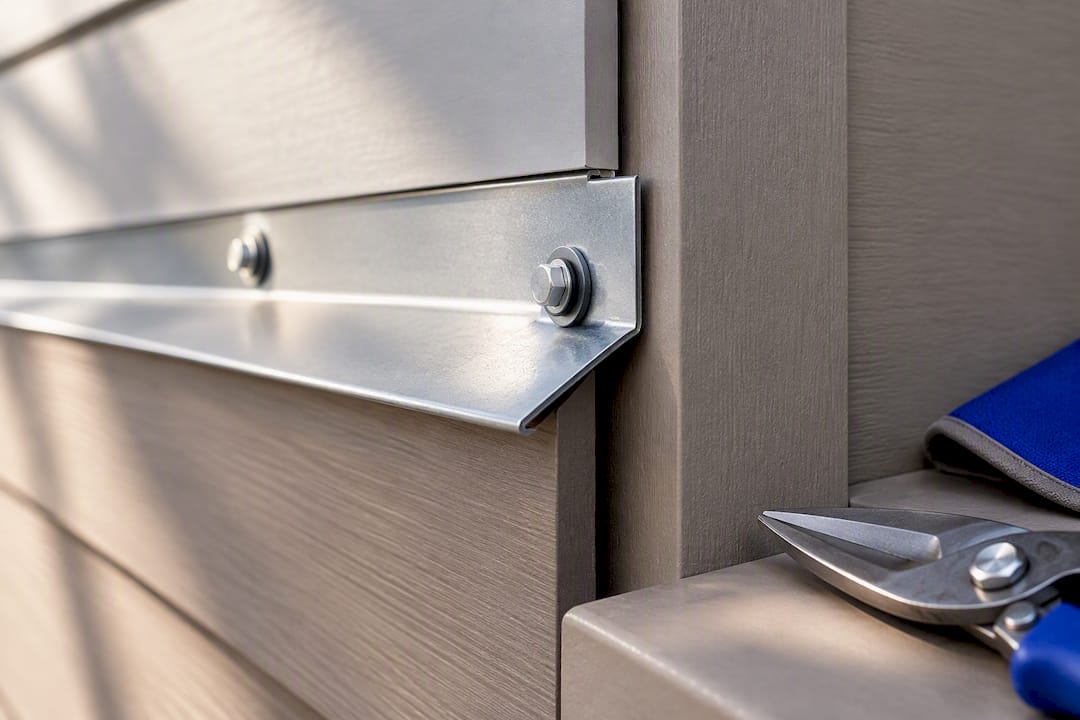
- Use stainless steel or hot-dip galvanized fasteners throughout. These remain the industry standard for coastal projects because they resist the rust that ordinary coated screws can't survive within a few salt-air seasons.
- Isolate dissimilar metals with non-conductive washers or gaskets wherever aluminum meets steel. Galvanic corrosion happens fast when two different metals touch in a salty, humid environment.
- Detail every seam, flashing, and penetration with self-adhered membranes rather than caulk alone. Caulk fails; a properly lapped membrane keeps working for decades.
- Consider prefabricated pile or dock modules for waterfront structures. Off-site prefabrication reduces the risks and costs tied to in-water construction work, a practice increasingly common on pile-supported and floating dock projects.
Pro Tip: Ask your contractor what grade of stainless steel they're specifying. Grade 316 resists chloride pitting significantly better than the more common 304, and the price difference is minor compared to the cost of replacing corroded hardware in five years.
What Do These Materials Actually Cost Over Time?
The sticker price on a material rarely tells the real story. A coastal home that skips maintenance planning ends up paying for it twice, once at installation and again in premature repairs.
- Marine-grade concrete and FRP carry higher upfront costs but need almost no maintenance beyond periodic inspection, making their 25 to 30-year ownership cost lower than it first appears.
- HDPE systems need occasional cleaning but no sealing, painting, or refinishing, which keeps lifecycle costs predictably low.
- Aluminum holds up well with minimal upkeep once properly isolated from other metals, though scratched surfaces should be touched up promptly to prevent pitting.
- Fiber cement needs repainting roughly every 10 to 15 years but otherwise resists the rot and pest damage that drives wood replacement costs.
- Pressure-treated wood demands sealing or staining every one to three years in coastal exposure, and boards near grade often need replacing well before the rest of the structure.
If your budget allows it, the higher upfront cost of low-maintenance materials almost always wins over a 20 to 30-year horizon. If cash flow at the time of construction is the deciding factor, treated wood or standard fiber cement remain reasonable choices as long as you budget realistically for the upkeep they require.
How Does NG Construction Apply These Materials in Real Projects?
Southwest Florida throws every coastal stressor at a building at once: salt spray off the Gulf, relentless UV, and humidity that never really lets up. Buildwithng's project teams weigh those conditions against a homeowner's budget and design goals on every custom build and renovation in Cape Coral, Fort Myers, Naples, Bonita Springs, and Estero.
- On waterfront renovation projects, choosing fiber cement siding over standard wood lap siding has meant fewer repaint cycles and no rot repairs at the water line.
- Room additions near canals often call for FRP railings and stainless fasteners instead of standard steel hardware, avoiding the rust streaks that plague untreated metal within a couple of storm seasons.
- Commercial build-outs near the coast benefit from integrated WRB sheathing behind the exterior finish, cutting down on weather-related delays during construction.
Every project runs through the same process: a free estimate, transparent design-build management from the first blueprint through final inspection, and a workmanship guarantee that holds the build accountable long after the crew leaves. That combination of state-certified expertise and sustainable material choices is what keeps coastal homes performing well past their first decade.
How Are Rising Sea Levels Changing Material Choices?
Floodplain maps are being redrawn faster than most homeowners realize, and that shift is already changing what gets specified on coastal projects. Base flood elevations are creeping upward in many coastal counties, which pushes more construction toward materials that tolerate occasional saturation without structural damage.
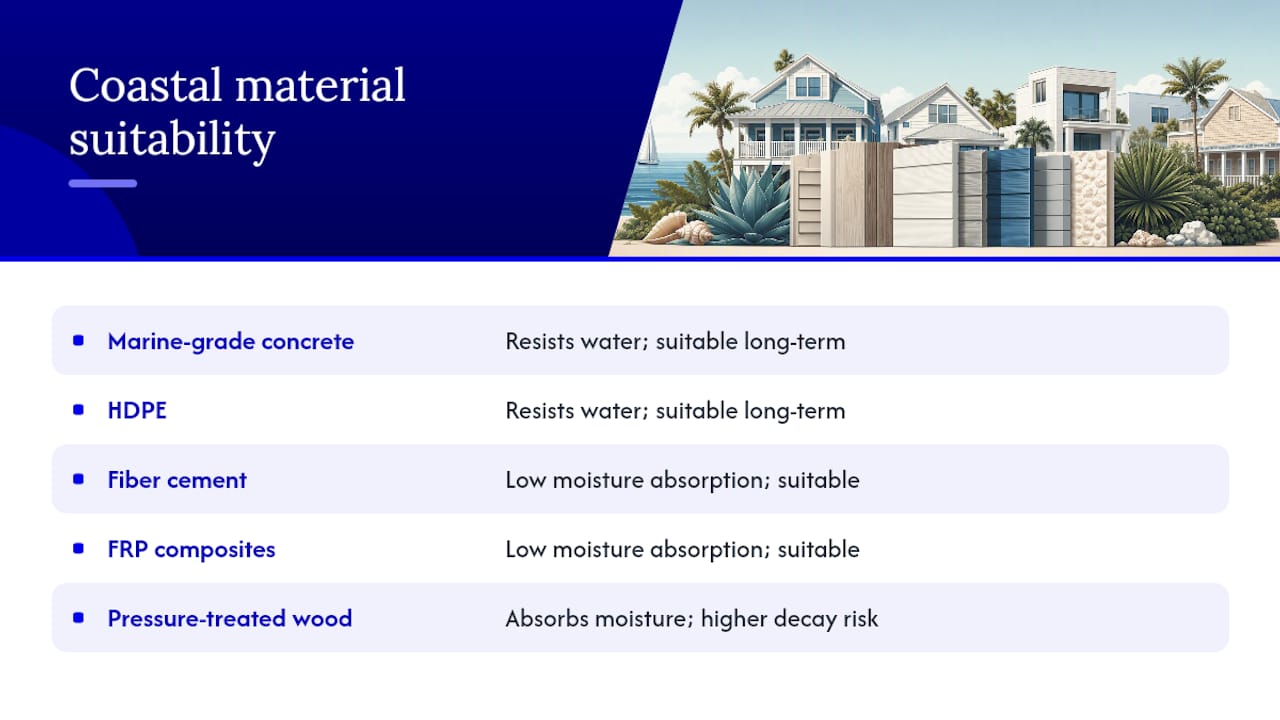
Marine-grade concrete and HDPE systems have an advantage here because neither degrades meaningfully from intermittent water contact. Fiber cement and FRP composites also hold up, since they don't absorb moisture the way wood does. Traditional pressure-treated wood, by contrast, becomes a riskier long-term bet in areas facing more frequent storm surge or elevated water tables, since repeated saturation accelerates decay even in treated lumber.
There's a broader industry shift toward recyclable composites and chemically inert plastics in dock and decking construction, driven partly by changing water levels and maintenance concerns. Builders are increasingly specifying floating dock systems that can adjust to fluctuating water levels rather than fixed structures that become liabilities as conditions change. For homeowners planning a 20 or 30-year ownership horizon, that trend is worth factoring into material decisions now rather than after the next major storm forces the issue.
What Building Codes Apply to Coastal Construction?
Coastal construction codes exist because standard building requirements weren't written for 150-mph wind gusts and storm surge. Florida's building code includes wind-borne debris zones that require impact-rated openings or approved shutter systems, along with elevation requirements tied to base flood mapping in many coastal municipalities.
Permitting requirements for coastal projects typically cover foundation elevation, wind-load-rated roofing and fastening schedules, and impact resistance for windows and doors within designated wind zones. Seawalls, docks, and other waterfront structures often require separate permits tied to environmental review, since construction near the water line can affect protected shoreline habitats.
These requirements vary by county and even by flood zone designation within the same city, so a permit that worked for a neighbor's build five years ago may not apply to a new project today. Working with a contractor familiar with local permitting requirements, rather than assuming a generic checklist applies, is often the difference between a smooth approval process and months of delay. Buildwithng's design-build teams handle permitting and code compliance as part of every project's process, from initial architectural blueprints through final inspection.
What Coastal Homeowners Get Wrong About Material Choice
The biggest mistake in coastal material selection isn't picking the wrong product. It's assuming the material alone determines how a home performs. A premium composite deck installed with the wrong fasteners fails just as fast as pressure-treated pine, because galvanic corrosion doesn't care what the surface material costs.
Conventional advice tends to frame this as a simple ranking: concrete and composites good, wood bad. That's directionally right but misses the more useful point. Detailing determines outcomes as much as material grade does. A fiber cement exterior with poorly flashed window penetrations will let water in behind the cladding regardless of how good the siding itself is. A marine-grade concrete seawall poured without attention to reinforcement cover will still see chloride reach the steel eventually.
If there's one thing coastal homeowners should prioritize first, it's asking a contractor how they handle the connections, not just which materials appear on the estimate. The seams, the flashing, the fastener grade, and the weather barrier behind the finish are where coastal builds actually succeed or fail. Get those right, and even a mid-tier material family will outlast a premium one installed carelessly.
— Alston
Ready to Build With Materials That Actually Hold Up?
A reputable contractor can offer homeowners a single accountable, certified team managing every phase of a coastal build, from choosing siding and fasteners to final inspection, backed by a workmanship guarantee. Instead of coordinating separate vendors for framing, weather barriers, and finishes yourself, and hoping each one details their work correctly around the others, Buildwithng manages material selection and installation as one continuous process.
That matters most at the connection points this article just covered. Permitting, fastener grade, flashing details, and vendor coordination are exactly where coastal projects run into trouble, and exactly where a single accountable team prevents it. Whether you're planning a new custom home, a waterfront renovation, or a commercial build-out in Cape Coral, Fort Myers, Naples, Bonita Springs, or Estero, request your free, no-obligation estimate and get a transparent project plan built around materials that are actually suited to your site.
Sources
- Concrete performance in marine environments — James Cook University research
- ForceField Weather Barrier System — Georgia-Pacific
- VYCOR® underlayments — CertainTeed product page
- Dock Construction Guide for 2026 — Marine Construction Source
FAQ
What Are the Best Building Materials for Coastal Areas?
Marine-grade concrete, fiber-reinforced composites, HDPE plastic systems, and aluminum lead the list for saltwater and UV resistance. Fiber cement and properly detailed pressure-treated wood remain solid choices for siding and decking when paired with the right weather-resistive barriers and corrosion-resistant fasteners.
How Do I Prevent Galvanic Corrosion on a Coastal Build?
Use stainless steel or hot-dip galvanized fasteners throughout, and isolate dissimilar metals like aluminum and steel with non-conductive washers. These practices are considered the industry standard for coastal and marine projects.
Are Weather-Resistive Barriers Necessary for Coastal Homes?
Yes. Systems like ForceField and WeatherSmart manage moisture behind your siding before it becomes trapped, rotting the structure from the inside. ForceField has shown drainage efficiency above 90% in ASTM-tested wall assemblies.
Does Buildwithng Handle Material Selection for Coastal Builds?
Yes. Buildwithng manages material selection as part of its design-build process for new construction, renovations, and additions across Southwest Florida, backed by a workmanship guarantee. Every project starts with a free, no-obligation estimate at Buildwithng.
How Much Does It Cost to Build With Low-Maintenance Coastal Materials?
Costs vary by project scope, material selection, and site conditions, so there's no single figure that applies across the board. Buildwithng provides a transparent project estimate after evaluating your specific site and goals, available through a free consultation at Buildwithng.